

Love anime or stories but feel your Japanese isn’t improving? This pillar guide shows how to turn entertainment into real progress with an AI-optimized learning loop, daily routines, and practical speaking practice.
- TL;DR (Quick Start)
- Who This Roadmap Is For
- The Promise (Your Results)
- The 3-Minute Self-Check (Pick Your Route)
- Step 1 — Choose the Right “Story Material” (No Title Lists)
- Step 2 — The AI-Optimized Learning Loop (The Core System)
- Daily Templates (15 / 30 / 60 Minutes)
- Skill Shortcuts (Pick Your Priority)
- Common Pitfalls (And How to Fix Them)
- Your Weekly Plan (Simple & Sustainable)
- Next Articles to Read (Cluster Hub)
- Final CTA (Pick Your Start Today)
TL;DR (Quick Start)
If you love anime or stories, you already have the best motivation. The missing piece is a system: how to extract useful lines, understand them correctly, review them efficiently, train pronunciation, practice conversation, and measure progress — without getting lost. This guide gives you a daily + weekly routine you can follow and adapt.
Who This Roadmap Is For
You’ll benefit most if…
- You’re a beginner to lower-intermediate learner (roughly N5–N3).
- You love anime, manga, games, light novels, or story-based content.
- You feel like you “study” but don’t see consistent improvement.
- You want a routine that’s fun to start and effective to finish.
What this roadmap is NOT
This isn’t a list of recommended anime titles. Your taste is personal. We focus on selection criteria + repeatable workflow so you can learn from almost anything you enjoy.
The Promise (Your Results)
30-day goal (minimum viable progress)
In 30 days, you’ll build a habit where you can:
- extract 1–3 useful phrases daily,
- understand them correctly,
- practice pronunciation with feedback,
- do short role-plays,
- keep a review loop that doesn’t collapse.
90-day goal (main target)
In 90 days, you’ll improve your practical Japanese by turning entertainment into structured input + output. You’ll stop “watching a lot” and start “learning a lot.”
180-day goal (advanced expansion)
In 180 days, you’ll reduce subtitle dependence and build more natural speaking patterns through repeated use and correction.
The 3-Minute Self-Check (Pick Your Route)
Quick diagnostic checklist
Score each item 0–2 (0 = no, 1 = sometimes, 2 = yes).
- Vocabulary: I recognize common everyday words.
- Grammar: I can explain basic patterns (〜ている, 〜たい, 〜てもいい).
- Listening: I can catch short sentences by sound (not by reading).
- Pronunciation: I can hear what sounds “off” in my own recording.
- Output: I can produce simple sentences without translating word-by-word.
Choose your route
- Route A (0–4 total): Complete beginner focus — build basics + habits.
- Route B (5–7 total): Core routine — balanced input/output.
- Route C (8–10 total): Plateau breaker — pronunciation/listening precision + natural output.
Suggested next reads:
- Route A → “First 30 Days for Absolute Beginners”
- Listening issues → “Why You Can’t Hear Japanese”
- Pronunciation focus → “Pronunciation & Pitch Accent Basics”
Step 1 — Choose the Right “Story Material” (No Title Lists)
The selection criteria that works for most learners
Pick content using these measurable factors:
- Dialogue density: More conversation, fewer long narrations.
- Everyday conversation rate: Daily life > specialized jargon.
- Clarity: Clean audio, not too many overlapping voices.
- Speed: Manageable without constant pausing.
- Repeatability: Scenes you don’t mind replaying 5–10 times.
- Subtitle options: Japanese subtitles available (ideal, not mandatory).
If certain anime or story-based content is region-locked in your country, a reliable VPN can help you access Japanese streaming libraries safely. I personally recommend NordVPN for its speed, stability, and privacy protection — especially when watching anime or studying Japanese online.
I explain how I personally think about this (and how I would use it responsibly for anime, Japanese study, and everyday online safety) in this article → How I Would Use NordVPN as a Japanese Fantasy Writer (For Anime, Japanese Study, and Online Safety)

How to avoid “too hard, too soon”
If you need to pause every 2 seconds, your material is too difficult for mining. Use it for enjoyment, but mine from easier scenes first.
Suggested next read:
Materials decision (don’t switch—score and lock your A/B plan)
If you keep changing anime, podcasts, or videos, the issue is usually not motivation — it’s a mismatch. Use the quick onboarding below to score your options in minutes and lock a simple A/B plan (Study vs Enjoy).
- Quick onboarding (10 min): Material Scoring Toolkit
https://yuisjapanlab.com/material-scoring-toolkit-onboarding/ - Use cases:
Stop Switching Materials (5-min score + fixed A/B plan)
https://yuisjapanlab.com/stop-switching-japanese-materials/
Study vs Enjoy (A/B system for fun content)
https://yuisjapanlab.com/study-vs-enjoy-japanese-input/
Toolkit: https://yuisjapanlab.gumroad.com/l/ovguy
Step 2 — The AI-Optimized Learning Loop (The Core System)
This is the heart of the roadmap: Extract → Understand → Review → Pronounce → Converse → Evaluate
2A) Extract (Sentence Mining)
Goal: Collect 1–3 lines that are (1) useful, (2) natural, (3) reusable.
What to extract:
- Short lines (5–12 seconds),
- Lines you can imagine saying,
- Lines with one clear structure.
AI prompt (copy/paste):
“Here is a sentence from a story. Break it down into grammar, literal meaning, natural meaning, and when a native would use it. Then give me 3 similar sentences I can reuse. Finally, warn me if this sounds like role language or unnatural in real life.”
Suggested next read:
2B) Understand (Meaning & Grammar without guessing wrong)
AI can accelerate learning, but you must add a safety step:
- Confirm particles/verb forms,
- Check if the tone is casual/polite,
- Check if it’s anime-style / role language.
Mini verification method (copy/paste):
“Give me: (1) a neutral version, (2) a polite version, (3) a realistic everyday alternative. Explain the difference in tone and when to use each.”
Suggested next read:
2C) Review (SRS so you don’t forget)
Turn each mined line into a review item:
- Front: audio or the Japanese line
- Back: meaning + one grammar note + your own example
Simple review schedule: Day 1 / Day 3 / Day 7 / Day 14
Suggested next read:
2D) Pronunciation (Record → Feedback → Fix)
You don’t need perfect accent. You need feedback loops.
Routine:
- Record the line (once).
- Compare to the original (listen for rhythm and vowel length).
- Re-record (twice).
- Write down only one fix (vowel length, pitch movement, consonant clarity).
Suggested next reads:
If you want this pronunciation step to stay consistent (and not disappear after a few days), I built a 15-minute shadowing routine that fixes the order, timing, and feedback points for you.
It’s designed so you don’t think — just run the same 15-minute loop once a day and stop.
https://yuisjapanlab.gumroad.com/l/shadowing-routine-kit
If you want to see exactly how to use this routine day by day (and how I personally run it in under 15 minutes), start here:
→ https://yuisjapanlab.com/15-minute-shadowing-routine-kit-onboarding/
2E) Conversation (Role-play so it becomes yours)
Use AI for short role-plays:
- 3 turns only, based on your mined line.
- Ask the AI to correct only the most important mistake.
- Then redo the same role-play with one variation.
Role-play prompt (copy/paste):
“Role-play with me in Japanese using this line as the key phrase. Keep it to 3 turns. After my reply, correct only my #1 most important mistake and give me one natural alternative. Then repeat the same role-play with a slightly different situation.”
Suggested next read:
If you want real conversation practice with native speakers to reinforce these patterns, you can try italki, where you can book short, affordable 1-on-1 sessions with Japanese tutors. It’s the easiest way to turn your mined lines into real conversations.
I explain in detail how I personally use italki for this purpose in this article →
How I Would Use italki to Learn Japanese (From a Japanese Fantasy Writer’s Point of View)
If conversation practice feels random or exhausting, the problem is usually design, not ability.
This Role-play Script Library (Core 100 + Bonus 100) is built around one fixed rule:
3-turn role-play (You → AI → You → AI → You) — short, repeatable, and correction-light.
You practice with one script, fix only one mistake, save one chunk, and move on.
That’s how speaking actually compounds instead of burning you out.
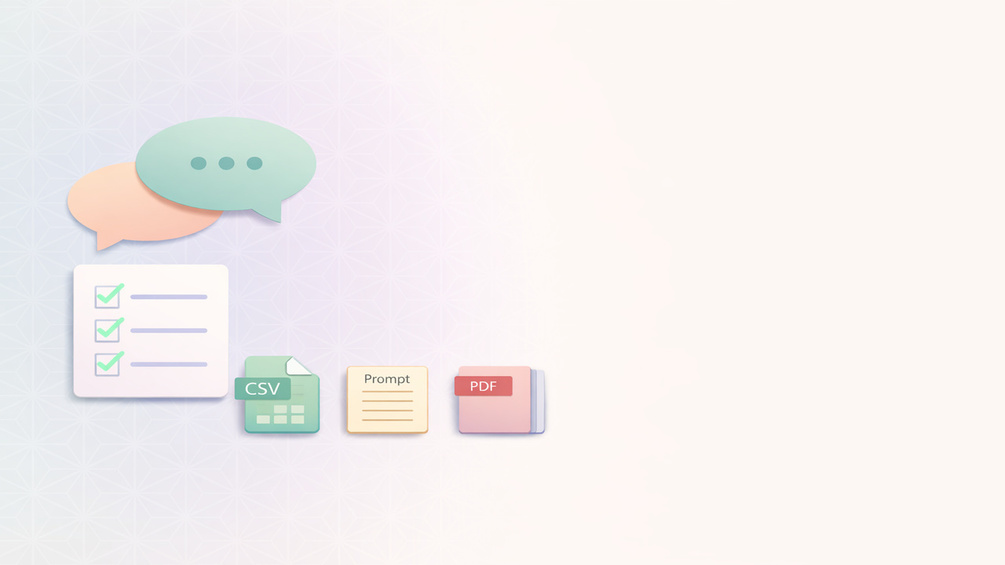
If you’re unsure how to run the 3-turn role-play loop without overcorrecting or overthinking, this guide walks you through the exact routine step by step:
→ https://yuisjapanlab.com/japanese-conversation-system-pack-onboarding/
2F) Evaluate (Weekly mini-test)
Once a week:
- Pick 10 lines from your week,
- Listen → explain meaning,
- Produce your own similar sentence,
- Record 2 lines and compare again.
If you keep fixing the same mistakes over and over, the issue isn’t effort — it’s that there’s no system to see and redesign those errors.
This is why I use a Mistake Notebook System Dashboard:
you log only high-signal mistakes, run a 10–15 minute weekly review, and track one metric — Repeat Rate — to confirm that your study is actually improving.
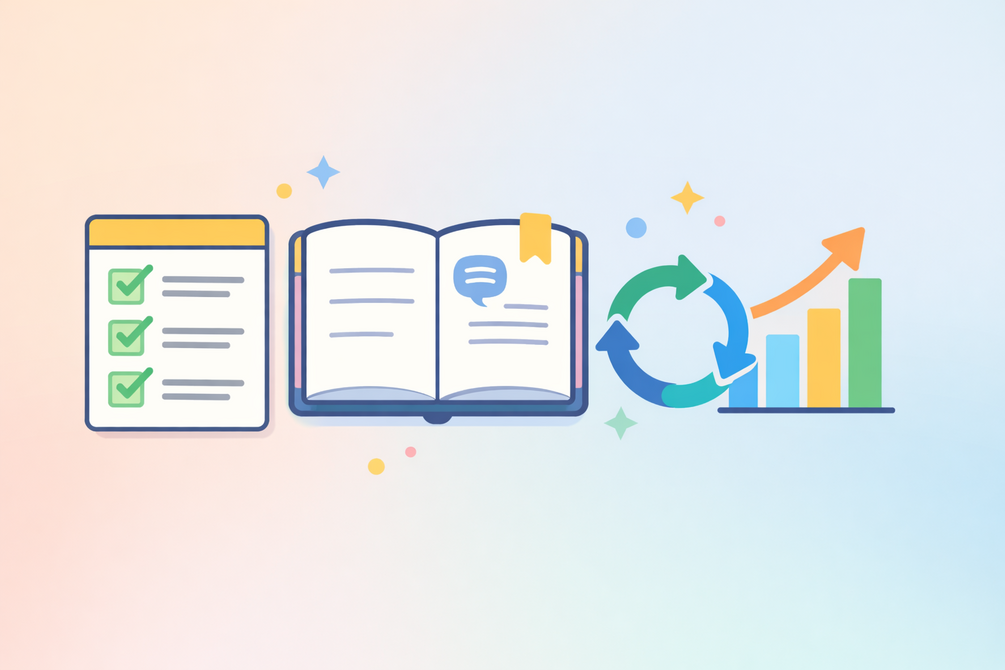
To avoid setting this up wrong or tracking too much, this onboarding guide shows the minimal daily and weekly flow I recommend:
→ https://yuisjapanlab.com/mistake-notebook-system-dashboard-onboarding/
Daily Templates (15 / 30 / 60 Minutes)
15-minute minimum routine
- Watch (3 min)
- Extract 1 line (3 min)
- Understand with AI (4 min)
- Record twice (3 min)
- 1 short role-play (2 min)
30-minute standard routine
- Extract 2–3 lines
- Create SRS cards + one personal example each
- Shadowing (5 minutes)
- Role-play (3 turns)
60-minute growth routine
- Extract 5 lines
- Create 3 variations each
- Shadowing + record compare
- Role-play (5–8 turns)
- Align with your weekly goal
Skill Shortcuts (Pick Your Priority)
If grammar doesn’t stick
Focus on “pattern → example → substitution.” Learn one structure deeply instead of collecting many lines.
If vocabulary doesn’t grow
Your issue is usually review design, not memory. Reduce new items and increase review quality.
If listening is the problem
Diagnose the cause: sound changes, missing particles, unknown words, speed and chunking.
Suggested next read: Why You Can’t Hear Japanese (Even If You Study): A Practical Checklist + Fixes
If you can’t speak naturally
Stop translating word-by-word. Build “ready-to-use chunks” and practice in role-play.
Common Pitfalls (And How to Fix Them)
“I watched a lot but learned little”
Cap viewing time and force extraction + review.
“AI gave me something weird”
Use verification: neutral/polite/real-life alternative versions.
“Entertainment language isn’t real-life Japanese”
Learn what’s natural and create real-life variants.
Suggested next read: Anime Japanese: What’s Usable vs Not-Usable (And How to Convert Lines to Real-Life Japanese)
Your Weekly Plan (Simple & Sustainable)
Beginner schedule (3–4 days/week)
- 3 days: 15–30 min routine
- 1 day: weekly test + review reset
Standard schedule (5–6 days/week)
- 5 days: 30 min routine
- 1 day: mini-test + pronunciation focus
Intensive schedule (daily)
- 6 days: 30–60 min
- 1 day: deep review + speaking session
Next Articles to Read (Cluster Hub)
- First 30 Days for Absolute Beginners
- How to Choose Materials That Improve Your Listening
- Sentence Mining: Extract → Understand → SRS (Step-by-Step)
- Usable vs Not-Usable Japanese: Anime Lines That Mislead Learners
- Why You Can’t Hear Japanese: A Checklist
- Shadowing in 15 Minutes: A Daily Routine
- Pronunciation & Pitch Accent Basics
- AI Correction Templates: From Writing to Natural Japanese
- Conversation Design: Solo Practice, AI Role-play, and Tutors
- The Mistake Notebook System: Review That Actually Works
- Troubleshooting Guide: Grammar / Vocabulary / Motivation
- Copyright & Quoting Safety: Using Anime Lines Responsibly
Final CTA (Pick Your Start Today)
Start in 15 minutes
Do the 15-minute routine once today. Save your first line. Tomorrow, review it.
Or choose your route
- Route A: First 30 Days of Japanese (with Anime & Stories + AI): A Simple Plan That Actually Works
- Route B: Follow the 30-min routine
- Route C: Focus on pronunciation + listening diagnosis