
If you want to speak Japanese more, the biggest problem often isn’t grammar or vocabulary.
It’s this:
You don’t have a consistent way to practice speaking—especially when you’re alone.
So instead of “waiting until you find a partner,” build a solo system that makes speaking unavoidable, repeatable, and low-stress.
This is the exact structure I recommend for solo conversation practice—using short role-play scripts and one strict rule: keep it small enough to repeat.
The Real Issue: “I Can Study, but I Can’t Speak”
Many learners have plenty of input (videos, textbooks, apps), but speaking still feels impossible because:
- You don’t know what to say (blank mind)
- You don’t have a partner on demand
- You try to practice “freely,” so it becomes messy and exhausting
- You get too much correction, so you stop
The fix isn’t more motivation.
The fix is a speaking routine with guardrails.
The Solo Conversation Routine (10 Minutes)
Here’s a simple loop that works even when you’re tired:
Step 1) Pick ONE Role-Play Script
Choose a short script for a real-life situation (ordering, asking, explaining, reacting).
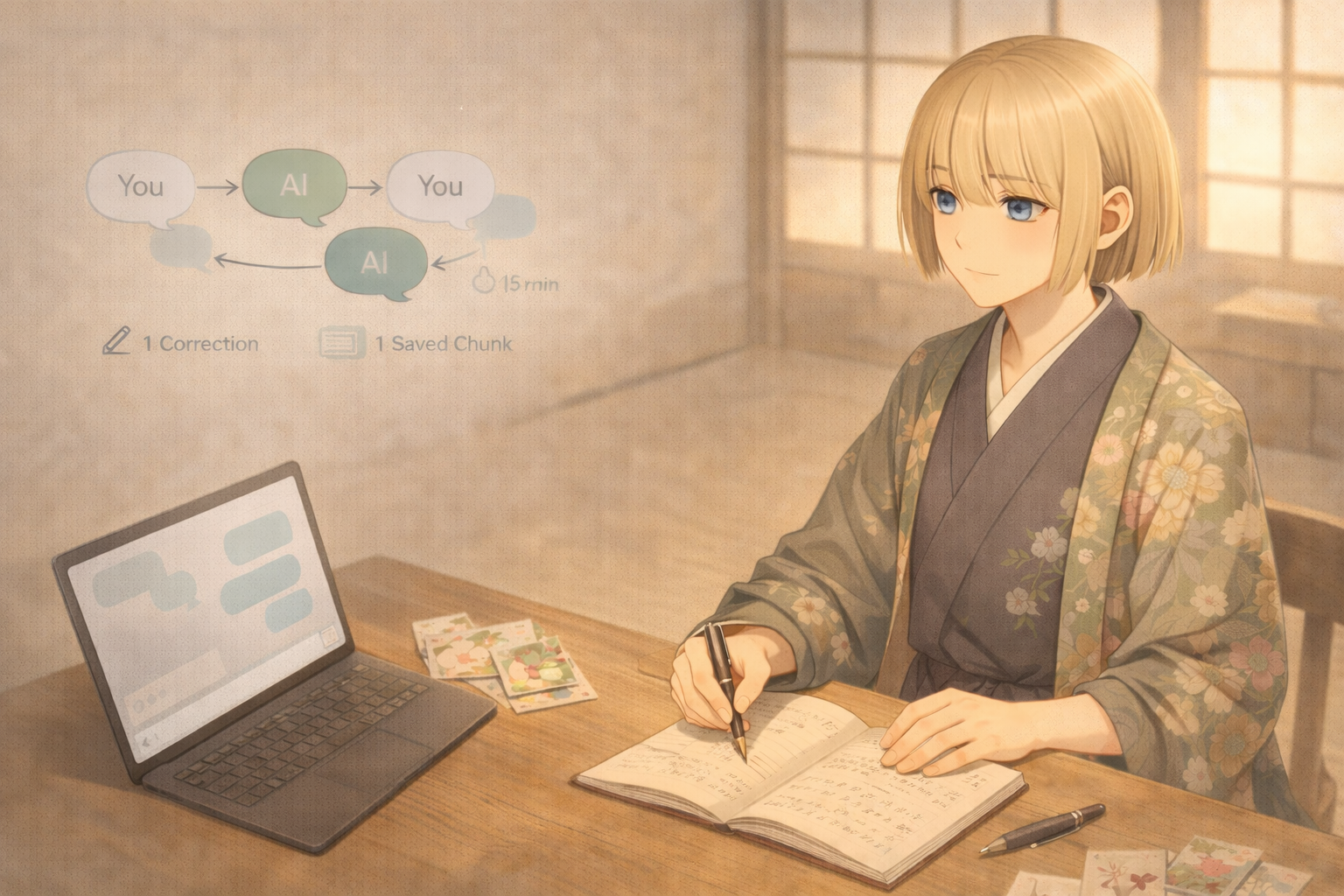
Step 2) Do a “3-Turn Role-Play”
You speak three times. That’s it.
You → AI → You → AI → You
This is long enough to feel like conversation, but short enough to repeat daily.
Step 3) Fix Only ONE Thing
After the role-play, pick one correction only (one phrase, one word choice, one grammar point).
Minimal correction keeps practice moving.
Step 4) Save ONE Chunk
Save one reusable line you can actually deploy again (a phrase, a sentence pattern, or a response template).
Step 5) Do ONE Variation
Repeat the same role-play once with a small change (a different item, time, place, reason, emotion).
Then stop. Consistency beats perfection.
Why Scripts Work When “Free Conversation” Fails
Role-play scripts solve the three problems that kill solo speaking:
- No topic anxiety (the situation is already defined)
- No partner problem (AI can play the other role instantly)
- No chaos (the structure is fixed, so you can repeat it)
That’s why scripts feel “easy” in the best way: they remove decision fatigue.
What to Do When You Feel Stuck Mid-Conversation
If you freeze, don’t restart.
Use a rescue line:
- “Let me think for a second.”
- “How should I say this in Japanese?”
- “Can I say it in a simpler way?”
Then keep going. You’re training continuity, not performance.
Next Steps (Gentle Links)
If you want the broader explanation of how solo conversation practice should be designed (and why it often fails), read the cluster article:
Japanese Conversation Practice: A Smart System (Solo + AI Role-play + Tutors)
If you want the ready-to-use system (role-play script library + copy/paste prompts + setup guide), use the onboarding page:
Japanese Conversation System Pack — How to Use It